
Trust in AI: What adoption really looks like for Gulf SMEs
An article by Ahmed Sameh, Chief Marketing Officer at Fortis
Every AI story coming out of the UAE this year seems to feature the same cast: sovereign AI strategies, enterprise transformation programmes and government ministries preparing to deploy agentic AI across 50% of federal services and operations within two years.
It’s an impressive story, but it is also the wrong one if you want to understand how AI is changing the way most Gulf businesses operate. Small and medium-sized enterprises (SMEs) account for 94% of businesses in the UAE, according to the Ministry of Economy, yet relatively little of the AI conversation focuses on them.
We see the gap between these two stories every day. What we hear from merchants rarely matches the enterprise AI narrative. Their concerns are more practical, their resources more constrained, and their adoption story arguably more interesting.
The readiness gap
A 2025 study of 315 respondents from UAE hospitality SMEs found that top management support was among the strongest predictors of intention to adopt AI, alongside competitive pressure and government regulation. These factors carried more weight than the technology’s perceived usefulness.
The problem is not simply whether the technology works. It is whether someone inside the business trusts it enough to champion it and has the time to put it to use.
This helps explain why so much enterprise-grade AI tooling falls flat with SME merchants. A restaurant owner running three venues with a skeleton back-office team does not need a sprawling analytics suite that requires a dedicated administrator to configure.
During our field research with food and beverage (F&B) merchants, operators often described software decisions in terms of risk rather than features. They wanted fast checkout, an easy way to set up menus, minimal staff training, reliable support and clear pricing.
Our main conclusion was straightforward: "POS systems are chosen to minimise risk, not to maximise features."
That distinction matters. Enterprise software is often designed around the breadth of its capabilities, while SME merchants are primarily concerned with whether it will make their day-to-day operations easier or more complicated.
AI adapted from enterprise software can demand exactly what smaller businesses lack: dedicated IT staff, lengthy onboarding and patience for features built around problems they do not have.
Where AI adoption is taking hold
On the customer-facing side, AI is already changing how merchants sell. And much of that change is happening on customers’ terms, not merchants’.
Consumers in the region are increasingly using AI to inform their purchasing decisions. Tabby’s 2026 shopping survey, covering more than 20,000 respondents in the UAE and Saudi Arabia, found that 43% use AI to help decide what to buy. Among 18- to 29-year-olds, 51.8% have used AI somewhere in their shopping journey.
But adoption does not automatically mean trust. The same survey found that only 30% fully trust AI recommendations.
For merchants, the opportunity is clear, but so is the challenge. AI-powered ordering, personalised loyalty offers and customer messaging may help businesses respond to changing shopping habits, but only if customers see value in the experience.
We are observing a similar pattern from our end, although at an earlier stage.
In our research into merchants’ use of AI, the tools they had adopted independently — ChatGPT, Gemini and DeepSeek — clustered around a fairly consistent set of tasks.
Most of these were marketing-related: writing social media captions, generating campaign ideas and coming up with product names. Merchants were also using AI to explore pricing decisions, such as what to charge for a new item or how to structure a bundle or discount. A smaller number were experimenting with AI-generated product images.
What they had not explored, at least among the merchants we researched, was AI-powered sales analytics or forecasting.
That gap is not necessarily about hesitation. It is also about the limitations of the tools they are using. A standalone AI assistant has no visibility into a merchant’s actual business performance unless it is connected to the relevant sales and operational data.
And without that visibility, its usefulness has limits.
Operations present a different but equally pressing challenge. For UAE retailers and hospitality businesses, staffing and inventory planning can be complicated by employment costs, visa requirements and seasonal fluctuations in demand.
AI could help with forecasting, reordering and shift planning without requiring particularly sophisticated systems. But that is not what the merchants we speak to are asking for right now.
They want faster answers.
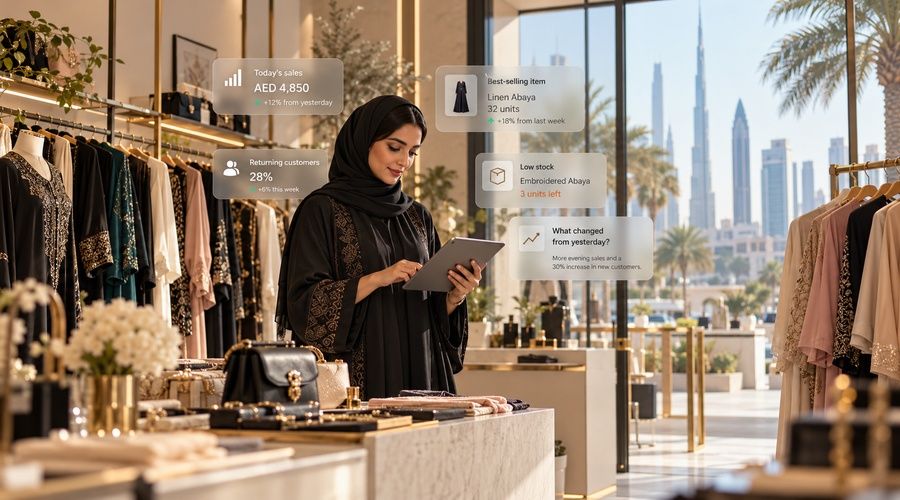
Not another dashboard, but a simple way to ask: What were today's sales? What changed from yesterday? What's selling best? Is anything unusual? Are we on track? Who sold the most? Which customers came back?
Across our research, one request came up more frequently than any other: "Tell me what's happening in my business right now."
That is a much more immediate starting point than predictive analytics. Before merchants can trust AI to tell them what might happen next week, they need to trust it to tell them what is happening today.
Why the gap will get harder to close
The difference between experimenting with AI and using it to improve business performance is already becoming clear.
McKinsey’s 2025 State of AI report found that organisations it classified as AI high performers, representing about 6% of respondents, were three times more likely than their peers to report strong senior leadership ownership and commitment to AI initiatives. They were also more likely to have moved beyond experimentation and started scaling AI across their businesses.
These findings concern organisations of different sizes, not Gulf SMEs specifically. But the underlying lesson is relevant: adopting AI tools and extracting measurable value from them are two different things.
For smaller merchants, the implications could be significant.
A restaurant that can anticipate a slow Tuesday and adjust staffing accordingly, or a retailer that can identify and re-engage customers who have stopped returning, may be able to operate more efficiently than a competitor relying entirely on manual decisions.
Over time, those advantages can compound, particularly in retail and hospitality, where margins leave little room for error.
But getting there requires tools designed around how SMEs actually operate: thin teams, tight margins and no time for a six-month rollout.
It does not require SMEs to become AI companies. Nor should they have to make do with a stripped-down version of a platform designed for a 500-person enterprise.
The starting point is simpler: it gives merchants access to their own business information in a way that is immediate, understandable and useful. Build trust through reliable answers before asking them to rely on more complex predictions or automated decisions.
For Gulf SMEs, the next stage of AI adoption may have less to do with how sophisticated the technology becomes and more to do with how well it fits the businesses expected to use it.
The merchants who find tools that fit will be better placed to pull ahead.

